

Preface: As this is a class assignment, I will reluctantly insert disclaimers. However, nudity and sex as it pertains to art should only offend a middle schooler.
Disclaimer Number 1: When googling this movie, type specifically “Nymphomaniac movie by Lars von Trier.” I made the mistake of simply typing “Nymphomaniac movie” which I very much regret.
Disclaimer Number 2: The scholarly article linked below has images of uncensored breasts and buttocks from the film. No male or female genitalia are shown, but there is also a photo of two shirtless men (ew). Below I have linked a PDF without the explicit imagery if you would prefer to read the article without the photos.
PDF: No Explicit Images.
Anddddd finally…Number 3: The movie has explicit pornographic scenes, and the following mature topics are discussed: Rape, underage sex, racism, sexism, pedophilia, incest, BDSM, and adultery. Do not watch the film if you are averse to these topics.
Lars von Trier only recognizes the director’s cuts linked below. The non director’s cut versions are not “legit.” These are available on Prime Video (for now).
Volume I: https://www.primevideo.com/detail/0LY62QW3KH4EK8LVXQEMS40H5Q/
I chose this film because it’s one of the most unique movies I’ve watched, but I understand it was a risky choice for a class assignment. Please don’t expel me. Thank you:)
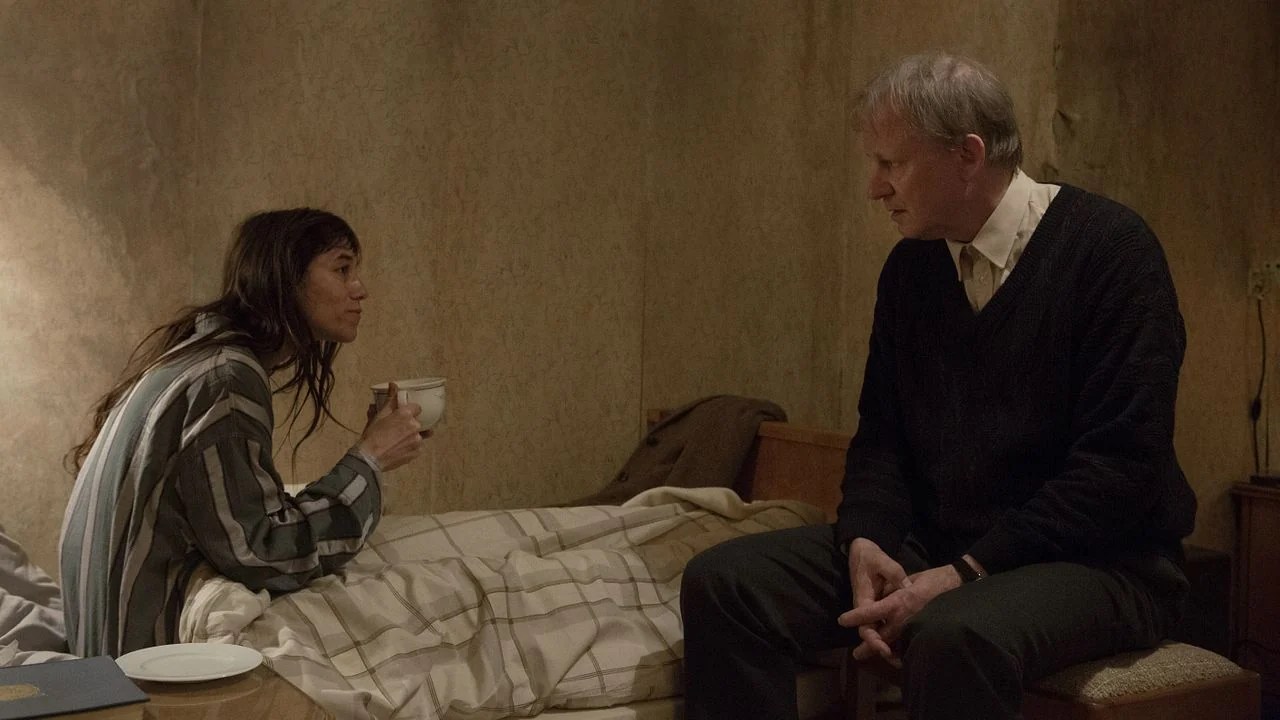
I cannot summarize this film in a paragraph. You will not understand the movie unless you watch it yourself. So, this is not a summary, just a few meaningless sentences that serve as an introduction to this blog post. Lars von Trier’s movie “Nymphomaniac,” volume I and II is a reality-adjacent story about Joe (played by the incredibly talented Charlotte Gainsbourg), a self-diagnosed nymphomaniac who, against the grain of society, fully embraces her lust. The story involves crime, Freudian themes, discussions of race and gender, as well as directly challenging society’s view of women as “docile and pure.”
“Men serve as instruments parallel to the classical male objectification of the woman.” ~Schepelern
It took me some time to find a free and respectable review of this movie. Many academic sources were locked behind pay walls. This, to me, is just more evidence of how severely underrated this movie is. Thanks to Kosmorana, a Danish film blog, I was able to find an article authored by Peter Schepelern that does well in pointing out the film’s commentary on gender roles and society’s tendency to demonize female sexuality and sex in general and the romanticizing of monogamy perpetuated by Christianity. (Yes, I realize monogamy is not singularly Christian, these are just the associations made in the movie).
Schepelern highlights the film’s metaphorical representation of Joe’s character saying her “detached hedonist lifestyle drains her life of meaning”, and the movie’s logo “( )” (meant to represent a vagina) also “announces emptiness, nothingness”, a void to depict Joe’s soul. There’s very little satisfaction to Joe and to the audience, as the end of volume II cannot be described as a “happy ending.” The movie is blunt, raw, and entirely unsatisfying, but it provides alternate perspectives on topics many are afraid to face. Not necessarily “true” or “better” perspectives. The movie’s purpose is to shine light on the dark corners of humanity.
“Nymphomaniac begins with darkness and it ends with darkness.”
A rather accurate description in the article about the films. Schepelern ends with a truth that many who have watched Nymphomaniac may disregard: The darkness is real. These sides of humanity that we like to pretend don’t exist, or that we at least ignore, are very, very real.
Kosmorama’s review of this article is very extensive and well written. I think some points may have been altered in translation, but it is otherwise spot-on to the film.
One of the things it mentions is the explicit pornographic scenes not being necessary for the plot, but very necessary to the point of the movie. In the scene below, when Joe says, “society demonstrates its impotence in the face of a concrete problem by removing words”…
please ignore the unprofessional video, I couldn’t find an official video of this scene.
I think the director’s personal views came through the character (and I say this based on Lars von Trier’s other movies and interviews) because the entire movie is bringing attention to things society would like to turn from and ignore. The discomfort in these scenes are intentional. It’s not “hot”, it’s awkward and cruel, and it’s meant to make the viewer uncomfortable. There’s a fairly popular sentiment that “bystanders aid the bully, not the bullied”, and while many claim to agree with this, I’ve noticed very few live by it.
To illustrate my point, I will use a rather graphic example, but this point applies to many different situations. This is just a case that happens far too often.
The idea of a child being sexually assaulted SHOULD make us feel sick and our instinct when things make us sick is to avoid it, to ignore it. Many people would rather accuse a child of lying than to face the reality of their husband/wife or any other close relative/friend molesting their son or daughter. They can’t face the feeling of it being true, so they ignore it which, obviously, harms the child.
If we can’t face these real issues that make us feel sick….if we can’t deal with the discomfort and discuss these problems, how can we trust ourselves to do the right thing if the issue becomes present in our lives? If we feel the need to ignore a film, book, or conversation about these things, we may end up ignoring the real situation where our help and involvement is actually needed.
It’s important not only to understand the victim and the innocent, but also to understand the predator and the darkness.
Just as people did with Novikov’s Lolita, many misunderstood this movie, labeling it “pornography” without looking any deeper than that, which in the end, just proves Novikov’s and Lars von Trier’s point:
People would rather close their eyes to the dark sides of humanity and blame a movie or book that shines a light on that darkness, than face the reality of it.


You did pick a risky but impactful potent film for this assignment. No worries about being expelled — I applaud your willingness to dive into something difficult. Your key theme about paying attention to often ignored aspects of sexuality is well argued. This: “The discomfort in these scenes are intentional. It’s not “hot”, it’s awkward and cruel, and it’s meant to make the viewer uncomfortable.” Your example of a child reporting sexual abuse to unreceptive adults is honest, painful.
Of note: I can imagine the results for the search “Nymphomaniac movie.” Yikes!
Excellent work finding the Peter Schepelern review for the film to use as your academic paper source. (Some of the work behind paywalls is available to you as a university student through the library.)
Thank you for the careful thought and presentation of this film and its criticism in a Danish film blog.
LikeLike