

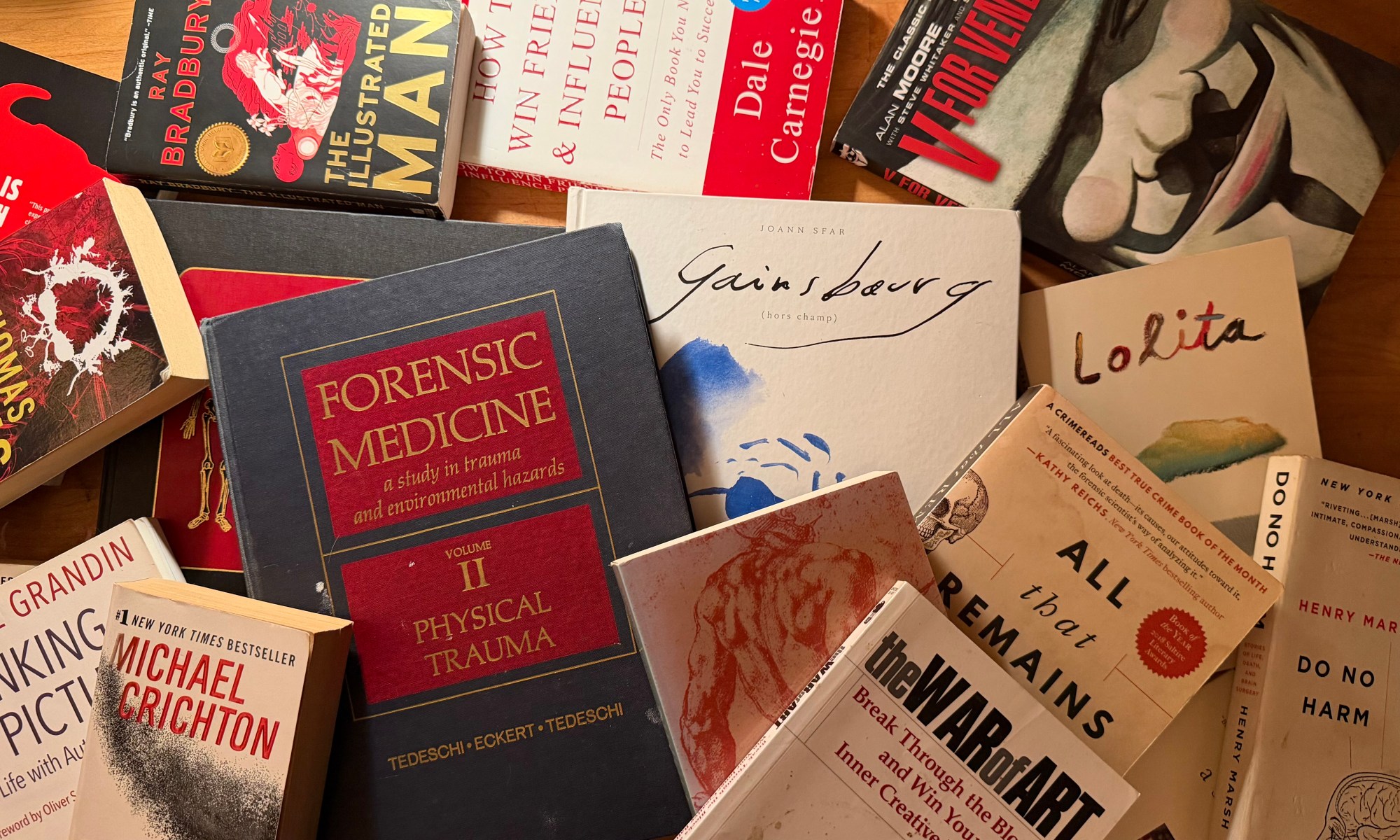
CONTENT WARNING: Academic discussion of topics which include rape, masturbation and sexuality. These topics are not discussed crudely. They are represented in a purely academic review of some old medical/legal textbooks.
CRASH COURSE; MEDIA LITERACY SUMMARIZED
PBS’s Crash Course on Media Literacy is a good start if you want a resource on how to think critically about the media you consume. It goes over 5 aspects of conscious media consumption; “Access, analyze, evaluate, create, act.” Access is what you’re capable of consuming. Analyzing is whether or not you understand the messages being conveyed. Evaluating has to do with your knowledge of who created the media and what their agenda may have been/what their reason was for creating the media. Create is your own experience in making media and what standards you hold yourself to. Acting is what you plan on doing with the media you consume and whether or not it’s productive or relevant to your life.
STEWART HALL’S VIEWS ON MEDIA AGENDA
Stuart Hall studied mass media “as it had to do with race and class.” He focused his studies on the ideologies and opinions authorities (such as the news) is spreading discreetly through TV programming and “educational content.” He argued that messages in the media were not accidental but intentional (even malicious) spreading of prejudices and biases that, if believed by the masses, could support a political or religious agenda.
He also pointed out the passive nature of humanity. This perspective is the only one that I have to slightly disagree with; I don’t think humans are inherently passive animals. I think it’s more natural for us to have a strong sense of justice and instinct. I think the passiveness, which is so prevalent today, has been taught to us; fed to us. TV and social media are a part of what keeps us in this passive, trance-like state.
There’s a quote from a song that I feel can explain what I mean better:
We sit in our house and slowly the world we’re living in is getting smaller
and all we say is please at least leave us alone in our living rooms
Let me have my toaster and my TV and my steel belted radios and I won’t say anything.
-“Network” Movie 1976
As long as we shut the door to dystopia, we’re somehow okay if our fellow man suffers from poverty, racism, trafficking or whatever else we don’t want to look at.
HOW AN OUTDATED MEDICAL TEXTBOOK CHANGED THE WAY I VIEW SCIENCE AND PSYCHOLOGY
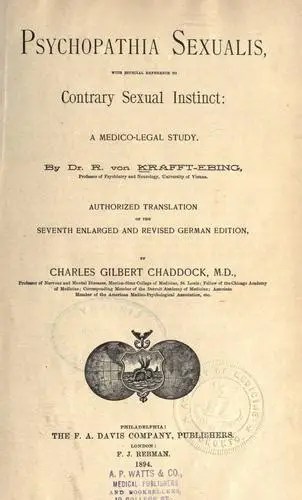
When I was 15, I went through a phase of reading old textbooks to gawk at the absurdity of such wildly inaccurate statements being conveyed in a very authoritative, factual manner. This is not the book I’ll be discussing, but to convey the bit of entertainment I’m referring to, I’ll provide a (then pearl-clutching) example from Psychopathia Sexualis by German psychologist Dr. A. von Schrenck-Notzing, published in 1898; “The boy had masturbated for years. This tendency was probably hereditary; for, as a mature man, his father was unable to overcome this evil habit. [……] but during hypnosis he [….] turned himself about.”(pg. 52)
This is a quote from Schrenck-Notzing’s section on using hypnosis to treat the horrific illness of masturbation. I am, of course, being sarcastic, but it is interesting to see what was passed off as “professional, academic” text when this entire supposedly scientific textbook was rooted in Christian ideologies.
Reading old textbooks like this make you wonder; if what they understood as fact then, we now understand as false, then what we understand now as fact may be considered hilariously absurd in the future.
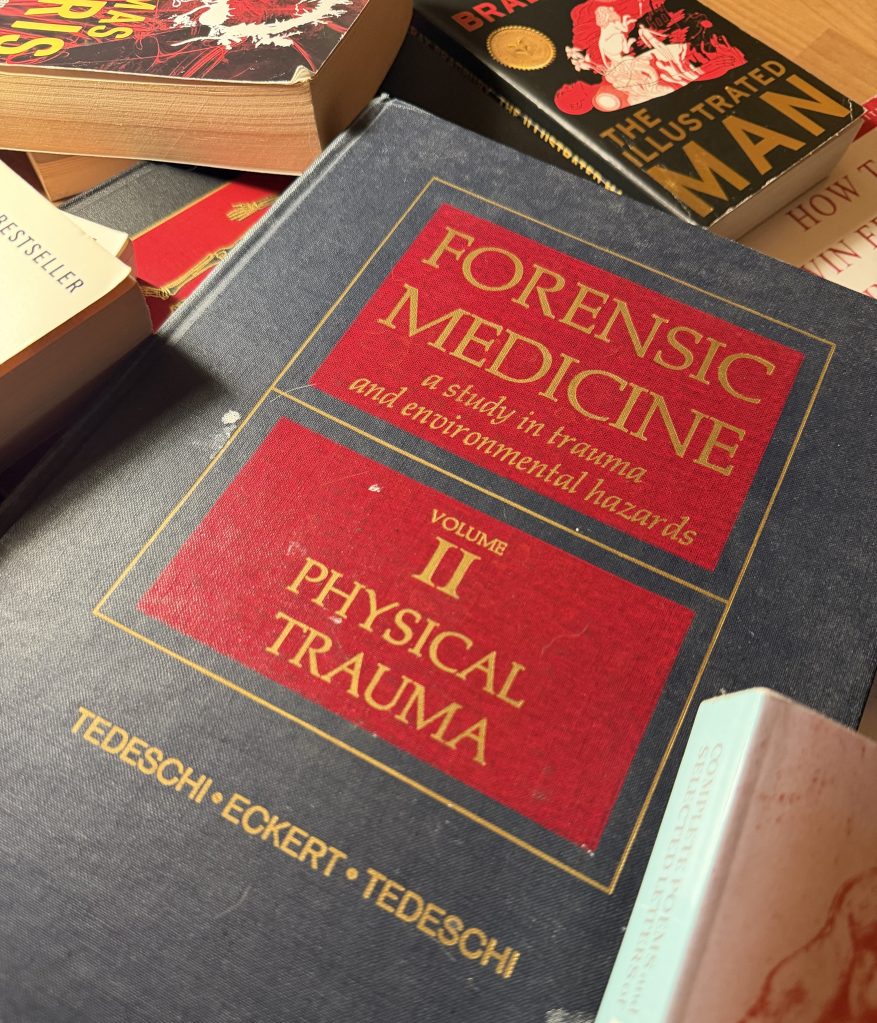
The textbook that I’ll be discussing is Forensic Medicine; a study in trauma and environmental hazards by Cesare G. Tedeschi (and other authors). This textbook was published in 1977 (Relatively recent for how inaccurate it is!). My copy is an old library book which was last checked out by some Colleen White in 1987 (see image below)
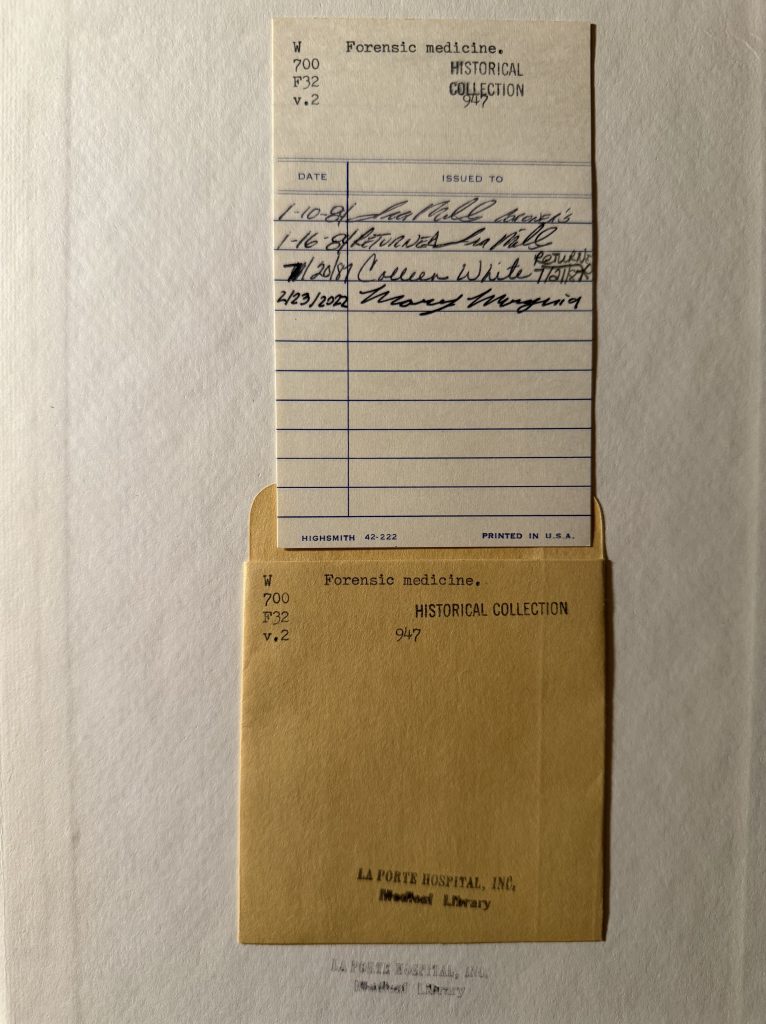
FAIR WARNING: I will briefly discuss sexual trauma as it relates to criminology. No graphic or violent descriptions outside of terminology. An outdated view of transsexuality will also be briefly discussed. If you do not want to read about this, feel free to skip to the conclusion/summary.
First, I will note some crisp inaccuracies:
Chapter 37: Rape | by Arthur F. Schiff.
“DEFINITION OF RAPE
A person who perpetrates an act of sexual intercourse with a female not his wife, against her will or without her consent […]” (pg. 939)
There are two main issues with this definition; firstly, it assumes only women can be raped. This is obviously, as we know today, false. If within the definition of rape, we only consider sexual intercourse and not other forms of sexual violation (ex; sodomization, assault, etc.) then it is known, at least in modern times, that men and boys can be raped by women.
There are plenty of cases of this occurring. So this is one falsehood in this “academic” text.
Another problematic suggestion is the woman “not his wife.” As we know today, marriage doesn’t automatically make it okay to “use” your partner. This idea likely comes from the perception of women as property or “servant” to her husband. Again, this ideology is not scientific and does not have any place in a supposedly medical or legal definition.
Before I make my point, I’d like to provide one more example:
Chapter 38: Sex Crimes and Abnormal Sexual Behavior | by William G. Eckert.
“Transsexualism is a personality disorder characterized by complete rejection of the individual’s genetic sex and […is associated with…] psychotic individuals.” (pg. 959)
(Personally, I am of the belief that with social media and the need to feel a sense of belonging, many people who consider themselves transsexuals are not truly transsexual. But my opinion about that is irrelevant and not productive).
However, the definition above, as we know, is inaccurate. Transsexualism (“being born in the wrong body” or “knowing who you are doesn’t match the body you were born with”), is a real, biological and observed phenomenon. There have been observed chemical, hormonal, and neurological differences between a transsexual person and a “typical” person. Transsexualism and homosexuality are categorized as “sexual deviations” and “crimes” in this textbook. That is obviously false as we understand now.
“TRUST NO ONE” ~ X-files 1996
These two examples made me question everything we learn in our educational system and all the legal, scientific and psychological “guidelines” we follow.
If these two things were considered “mental illnesses”, how many people today are we condemning to societal isolation and disorder that in just 50 years from now will not be considered illness?
If, in just 1977, non-consensual sex with one’s wife was not considered rape, legally, how many laws do we have today that we will realize only later are unjust?
If a book like this can be published in the name of “science, psychology, and law”, how much media do we consume today and take for granted as “scientific fact” or “justice” that only later we will look back on as complete and utter Bullsh*t?
IMPORTANT NOTE: If you for some reason get inspired to purchase this textbook for yourself; please be advised that there are entirely uncensored images of physical trauma and crime scene photos of sexual assault. If you’re interested in learning more about the book but are sensitive to gory images, I reccomend finding a summary of it online.


Hey! I really enjoyed reading this post. What stood out to me the most because it’s the most relatable was when you said, “Reading old textbooks like this make you wonder; if what they understood as fact then, we now understand as false, then what we understand now as fact may be considered hilariously absurd in the future.” The lack of applying and understanding this has become a huge crux of humanity. (e.g. religion)
The media of the last 5-10 years will be scrutinized heavily decades from now (I hope) for its absurdity. The amount of footage of corruption and incompetence will hopefully be used to help the masses decode whatever sort of media is allowed to exist in the future.
LikeLiked by 2 people
You have so much going on here. I love it! Summaries of Hall and Crash Course are succinct and useful. I’m a huge fan of how you use these media literacy ideas to take a look at the textbook propaganda published in years past. The masturbation quote from the late 1800s was sad, because think about the guilt and shame invoked on a zillion men.
Your discussion of Forensic Medicine; a study in trauma and environmental hazards would be a fabulous academic research project and publishable paper. So much going on that demonstrates Hall’s ideas of fixing meaning. And now we look at that and think, wow, we really have made **some** progress. Your conclusion is so important. If this 50-year-old textbook was so wildly inaccurate, what are we ingesting now that might be understood as completely false in a few years or decades?
You aptly write: “These two examples made me question everything we learn in our educational system and all the legal, scientific and psychological ‘guidelines’ we follow.” Yes. Question everything. Onward!
Thank you for this intrepid post.
LikeLiked by 1 person
Oh, oh, oh. The song you quote is quoting from the 1976 film “Network.” Here’s a fabulous clip with that monologue.
LikeLiked by 1 person
Hi! Thank you for pointing this out! I just changed the quote to cite the movie.
LikeLiked by 1 person
LikeLiked by 1 person
Hi there! This was such a fun read. There are so many odd and off-putting ideas in old text-books. It’s always fun to consider the time period and mindset of these individuals. As you brought up, “…it is interesting to see what was passed off as ‘professional, academic’ text when this entire supposedly scientific textbook was rooted in Christian ideologies.” In today’s society, there’s a constant spread of misinformation being spread by Christian organizations and the politicians they lobby.
LikeLike