

My Observations:
Below are two different halftime shows targeting two different audiences;
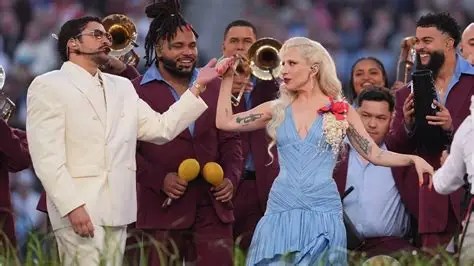
Bad Bunny’s Apple Music Super Bowl Halftime Show
TPUSA Presents: The ALL-AMERICAN HALFTIME SHOW
Bad Bunny’s performance was more typical of a halftime show, with a mixture of his and other artists, songs, background dancers, and many props. In this section, I’m sharing my observations and personal opinions on watching each halftime show. I should note; I don’t listen to Bad Bunny or Kid Rock, nor do I listen to Latin or Country music. My favorite musical artists are Lady Gaga and Eminem. So, I’m not the best judge when it comes to critiquing these performances.
First, let me share my notes on Bad Bunny’s show. There was quite a lot going on and I felt the background dancers were carrying his performance as there was, in my opinion, very little passion in his dances, facial expressions and voice. But again, I don’t know Bad Bunny, so perhaps that’s just his “look.” For me, the show was all over the place with many themes that didn’t seem related. I’ll list all the themes I noted here:
~ Corn farming
~ Nail techs
~ Wedding
~ Electricians
~ Mexican restaurant
~ Rave
~ Street Fashion
~ Orchestra
~ Fireworks
~ Acrobatics
Perhaps I don’t have the context to understand how these themes are related, but the performance felt unorganized and the energy Bad Bunny brought seemed underwhelming for such a major event.
Let’s move on to the Kid Rock concert. This performance had some of the same issues in my opinion. While there seemed to be more of a theme, the different songs felt a tad unorganized. For example, one song had the main singer in a Louis Vuitton bandana button-down shirt, and prop-like rock’n’roll gear. Then a few songs later, a performer was adorned in traditional 1700’s founding-father attire, complete with the split-tailed waistcoat and buckled shoes. Perhaps I’m too strict when it comes to cohesion, but those are two very different time periods that were awkwardly bandaged together in this performance.
The lyrics were awkward as well:
“And if you don’t like me, that means that I don’t like you too.”
I’m pretty sure I passed a note like that to my unrequited crush in elementary school.
Something that the Kid Rock concert did have going for them is they seemed a lot more passionate in their singing and in their performance.
Both concerts seem very odd from an artistic/director/writer standpoint, but these are just my surface level first impressions. We’ll get into the cultural significance of these two performances next.
SOME QUESTIONS FROM THE ASSIGNMENT:
Can you identify any cultural stereotypes?
I noticed a few stereotypes in both videos. I don’t think stereotypes by themselves are harmful. Stereotyping paired with mistreatment is where the problem is.
Stereotype def; “a widely held but fixed and oversimplified image or idea of a particular type of person or thing.” (Oxford Dictionary)
Simplification is necessary, for if we focused on all the complexities of every little thing, our brains would implode (not really, but you get what I’m saying). Unfortunately, stereotypes are harmful a lot of the times because people can take an oversimplification and use it as an excuse to look down on or mistreat a specific group of people instead of acknowledging that it’s a stereotype and not a complete truth.
I’m not going to name every stereotype I observed. I’ll highlight two that stuck out to me.
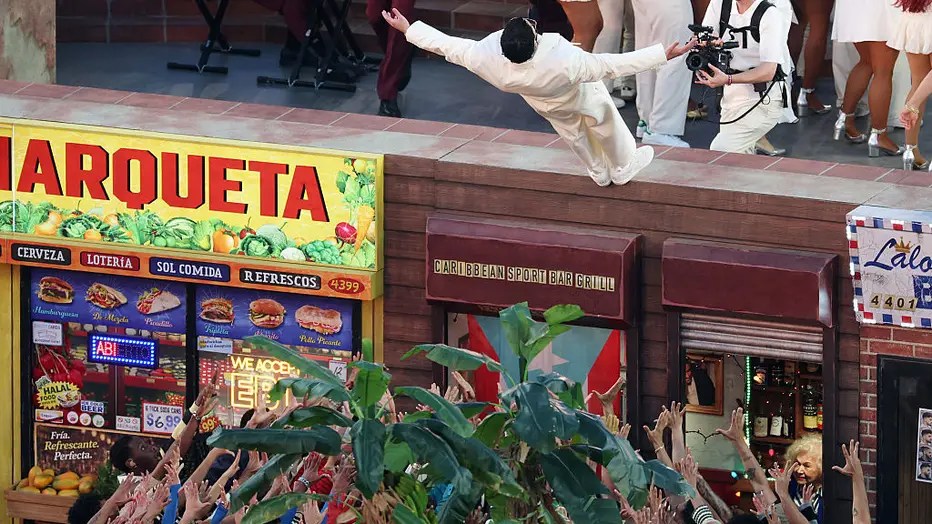
In Bad Bunny’s performance, there was a false Mexican restaurant, and in neon lights was the text: “We accept EBT.” Which is perhaps suggesting that people from Latin America and Mexico struggle with poverty. This was definitely an odd sign to have in the window of a Mexican restaurant prop for a billion-dollar industry, surrounded by wealthy people, including Puerto Rican singer Bad Bunny (who has a net worth of 140 million (estimated)).
(Here’s my totally-not-credible-source for this info: Bad Bunny Net Worth | Celebrity Net Worth But the exact number isn’t the point. The point is, he’s rich).
The contradiction was clear and the juxtaposition only seemed to highlight the stereotype (along with the cheap house set that he fell through the roof of).
For the Kid Rock concert, the stereotypes I observed may be self-imposed as I don’t think they were as intentional as Bad Bunny’s were. When watching one of the singers in his jorts and suspicious mustache, the distasteful thought that popped into my head was: “White, knobby-kneed hillbilly crackhead.” I don’t think this was intentional, but the “look” definitely fit a pre-existing (although very specific) stereotype.
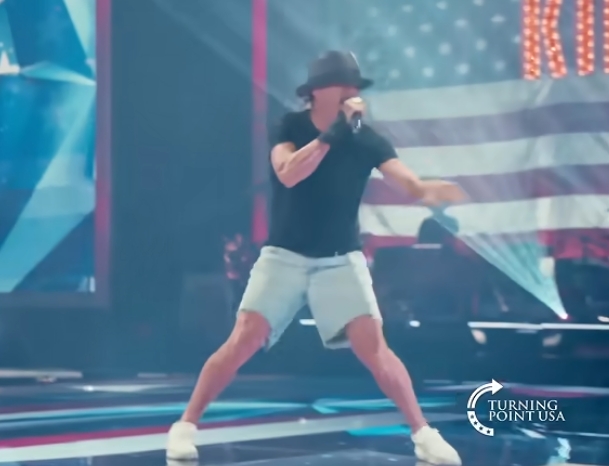
I thought about posting a reference image of what I mean by this stereotype but thought it might be a little inappropriate for this class assignment so if you don’t believe me just google “knobby knee hillbilly crackhead in jorts” at your own risk.
What do you think the intended audiences are for each performance?
I don’t think this question makes much sense. The term “intended audience” is usually used for marketing purposes (For example; an author writing a book designed to satisfy a specific type of customer so the author can make more reliable sales). But this isn’t the case for half-time show performers; The audience is not up to them or even really related to them. The audience is football fans (generally) who would probably go to the football game regardless of what the half-time show is.
The “intended audience” for a literal performance is obviously the literal audience. Everyone who bought their ticket for these games was the “intended” audience. But I’ll do my best to answer this question more in depth, anyway.
I think the Bad Bunny concert’s “intended” audience was Gen-Z and Gen-Alpha kids with short attention spans, because of everything going on, and all the set changes. I think the Kid Rock concert was more targeted towards older people because the performers were older.
I know this question is expecting me to answer based on political views, but I personally don’t think either performance was targeting a specific political group. The reason I don’t think this is each performer knew there would be a mixture of political views among the audiences.
Let me explain with an example; If a preacher is preaching at a Christian Church, I’d say that their target audience is Christians. But if a singer is singing at a football game open to people of many different political views, their target audience is everyone they’re singing to, regardless of politics. Even if the preacher is preaching about puppies or the singer is singing about God at the football game, the “intended” audience is more about who they’re directing their message to then the content of their message. Unless “audience” is being used as a metaphor here and if that’s the case, I’m completely lost.
That was a very long-winded way of saying, it would be some kind of strange psychosis if the “intended audience” was some abstract concept the performance was directed at instead of the audience right in front of them.
What significant messages do you identify in the overall performances and how might those messages impact an individual or a community?
I must be honest: I don’t think there are any significant messages in either of these performances. Perhaps I’m biased because I don’t care for football or either of these music groups, but at the end of the day it’s a football half-time show. I could write a book on the impact of Martin Luther King’s “I Have A Dream” speech and 1,000 essays on the impact of the bible or other serious pieces of media. And yes, I realize I could make up an answer just to get a grade but “significant” is a subjective term and I don’t want to lie about my opinion in an effort to stay professional. I think the most significant impact these performances likely had was bringing people together and having a memorable moment with their friends and family.
But do I think these performances have made a lasting impact? Or that people will still be thinking about them in 10 years? No, I don’t.
Lady Gaga’s halftime show from 2017 on the other hand….that will go down in history.


Hi!
I truly thought it was interesting at how you looked at both performances, without really being a fan of either artist. I also really like your point about the intent and audience, because I did not really think about it in that way. Even though I truly think both performances had very important messages behind them. I understand why you see them more as entertainment rather than something with a lasting impact.
LikeLiked by 1 person
Hi Maresol Murguia,
I also love lady gaga but even though we don’t listen to certain types of music we can still listen and appreciate others taste and form opinions regardless so thank you for sharing with us. I did notice at the beginning of your post you had talked about seeing things all over the place and then had created a list, from my understanding of the performance they were related to the cultural identity of bad bunny and possibly things that he himself grew up with or others that share his ethnicity also probably grew up with. The visuals of the designs were to represent the cultural understanding of bad bunny and his singing and brining that out was to show off this underrepresented side. I do agree that I myself and not the most knowledgeable on this but those were my thoughts and analysis. I do agree with you that stereotypes are not necessarily bad but when used to mistreat and create a consensus about somewhat just based of their appearance is bad, I’m sure you know the saying “don’t judge a book by its cover”. One thing about the Bad Bunny concert that you had mentioned was the stereotyping of Latin Americans as poor through the sign of the restaurant accepting ebt, this I think was more of a reference to Puerto Rico being a poor area and many relying on ebt to feed their family’s. Puerto Rico is not as infrastructure as the Americas as a whole and says a lot about what kind of living conditions they are in v.s. the United States as a whole. I do appreciate your transparency about your take and your feelings regarding this topic and do agree that the half time show for bad bunny was a to bring people together but I do believe their is significant messaging in both shows and a lack of willingness from some of the American population to be open and try something new when it comes to these large performances because to some it makes them uncomfortable.
Thank you for your input in regards to this topic though it is always nice to get others opinions and share with one another!
LikeLiked by 1 person